How to Choose the Right kVA Rating for a Servo Stabilizer: A Practical Sizing Guide
Picking a servo stabilizer usually comes down to one number: the kVA rating. Get it wrong on the low side and the unit trips, overheats, and fails to hold your voltage steady when you need it most. Get it wrong on the high side and you've paid for capacity you'll never use. This guide walks you through the exact method our engineers use to size a stabilizer correctly the first time.
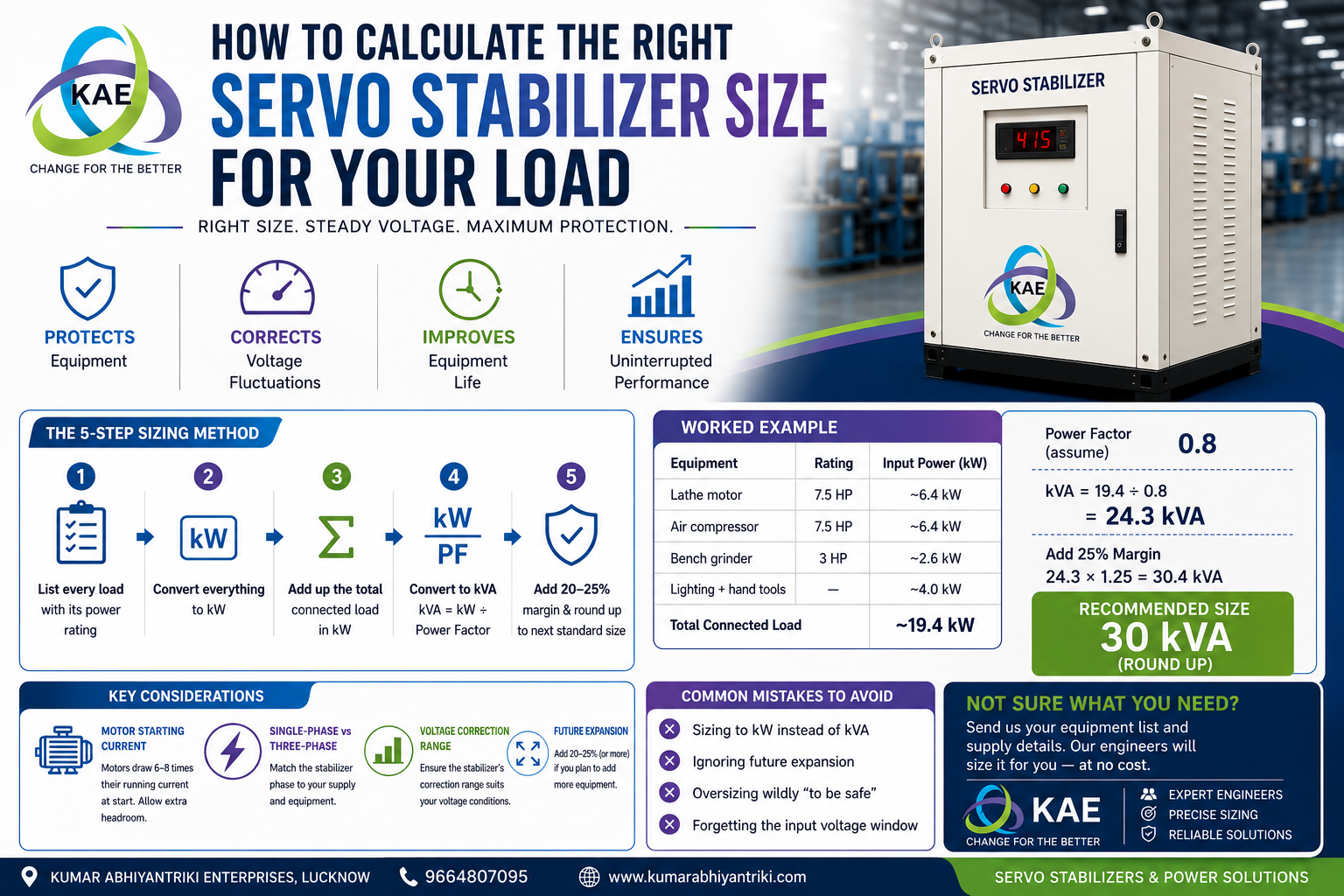
Quick answer: Add up your total connected load in kilowatts, divide by your power factor to get kVA, add a 20–25% margin for motor starting and future expansion, then round up to the next standard rating. A workshop drawing roughly 19 kW at 0.8 power factor lands on a 30 kVA stabilizer. The rest of this guide shows you why, and where that simple rule needs adjusting.
First, kVA is not the same as kW
This is the single most common mistake, so it's worth thirty seconds. Your equipment is often rated in kW (kilowatts — the actual work it does) or HP (horsepower), but a stabilizer is rated in kVA (kilovolt-amperes — the total power it has to handle). The two are linked by power factor:
kVA = kW ÷ Power Factor
Most industrial and mixed loads run at a power factor of around 0.8. So a 16 kW load isn't a 16 kVA load — it's 16 ÷ 0.8 = 20 kVA. Size the stabilizer to the kW figure and you'll under-buy by 20% or more. If your equipment is rated in HP, convert first: 1 HP ≈ 0.746 kW of output, and because motors aren't 100% efficient, the actual input draw is a bit higher (divide by the motor's efficiency, typically 0.85–0.90).
The 5-step sizing method
- List every load the stabilizer will feed — motors, machines, lighting, tools, everything — with its power rating from the nameplate.
- Convert everything to kW. For anything rated in HP, use input kW = (HP × 0.746) ÷ efficiency.
- Add up the total connected load in kW.
- Convert to kVA by dividing the total by your power factor (use 0.8 if you're unsure).
- Add a safety margin of 20–25% for motor starting surges and future expansion, then round up to the nearest standard rating.
A worked example
Say you're setting up a small fabrication workshop with the following equipment:
| Equipment | Rating | Input power (kW) |
|---|---|---|
| Lathe motor | 7.5 HP | ~6.4 kW |
| Air compressor | 7.5 HP | ~6.4 kW |
| Bench grinder | 3 HP | ~2.6 kW |
| Lighting + hand tools | — | ~4.0 kW |
| Total | ~19.4 kW |
Step 4 — convert to kVA: at a power factor of 0.8, that's 19.4 ÷ 0.8 = 24.3 kVA.
Step 5 — add margin and round up: with a 25% margin, 24.3 × 1.25 = 30.4 kVA. The nearest standard rating above that is 30 kVA — so a 30 kVA servo stabilizer is your baseline choice, and if the workshop runs several motors starting together you'd step up to 40 or 45 kVA (more on that next).
Don't forget motor starting current
Here's the detail that catches people out. An induction motor draws 6–8 times its running current for a moment when it starts — that's the inrush. If your load is mostly motors, especially large ones started direct-on-line (DOL), the brief starting surge can far exceed your steady-state kVA.
The 20–25% margin above covers this for a mixed load with modest motors. But if you have one large motor that's a big chunk of the total, or several motors that start at the same time, size up further — a common rule of thumb is to allow roughly double the largest motor's kVA as starting headroom. When in doubt, tell your supplier the size and starting method of your biggest motor and let them factor it in; it's cheaper than a stabilizer that trips every morning.
Single-phase vs three-phase
The method is identical, only the arithmetic behind kVA changes. Single-phase loads (most homes, small shops) use one live and neutral; three-phase loads (most industrial machinery) spread across three lines and are far more common above ~10 kVA. Match the stabilizer's phase to your supply and equipment — you can't feed a three-phase machine from a single-phase stabilizer, and a three-phase stabilizer expects a reasonably balanced load across all three phases.
Common mistakes to avoid
- Sizing to kW instead of kVA — the 20%+ shortfall we opened with.
- Ignoring future expansion — if you'll add machines within a year or two, build that into your margin now; upgrading later means buying a whole new unit.
- Oversizing wildly "to be safe" — a mild buffer is smart, but a stabilizer running at a tiny fraction of its rating is wasted capital and slightly less efficient. Right-sized beats oversized.
- Forgetting the input voltage window — kVA isn't the only spec. Check the correction range (how wide a voltage swing the unit can pull back to normal); a good rating with too narrow a window still won't protect you in a low-voltage area.
Frequently asked questions
What happens if my servo stabilizer is undersized?
Under full load it can't correct the voltage properly, runs hot, and its overload protection trips to save itself. Sustained overloading shortens the life of the unit and leaves your equipment exposed to the fluctuations you bought it to stop.
Is it bad to oversize a servo stabilizer?
Mild oversizing is perfectly fine and gives you useful headroom. Extreme oversizing just means you've spent more than necessary, and stabilizers are marginally less efficient when running far below their rating — so aim for right-sized with a sensible margin, not the biggest unit you can afford.
How do I size a stabilizer for a single air conditioner or one machine?
Take the equipment's kW (or HP × 0.746 ÷ efficiency), divide by power factor, and add ~25%. For a single motor-driven appliance like an AC, be generous with the margin because of starting inrush.
Should I account for future expansion?
Yes. Adding 20–25% on top of your current load is a good default, and more if you already know new equipment is coming. It's far cheaper than replacing an undersized unit later.
Still not sure what you need?
Sizing gets tricky once you have several large motors, unbalanced phases, or a very wide voltage range to correct. If you'd rather have it checked by an engineer, send us your equipment list and supply details and we'll size it for you at no cost — see our range of three-phase servo stabilizers and single-phase servo stabilizers, or get in touch for a tailored recommendation.
Kumar Abhiyantriki Enterprises has been building servo voltage stabilizers and power solutions in Lucknow for years. Real installations, real sizing — not a spec sheet copied off a catalogue.
Related Product
Servo Controlled Voltage Stabilizer
High-precision three-phase voltage stabilization for industrial loads.
View Servo Controlled Voltage Stabilizer